Verde Two / Articles / Jakarta Air Quality
Jakarta Air Quality: What the PM2.5 Numbers Really Mean for Your Health at Home
By UTTA · PT Berjaya Global Makmur · Last updated: 2026-10-17
Jakarta's Air in 2026 — The Numbers That Matter
Let's start with what the monitors actually say. According to IQAir's 2025 World Air Quality Report, Jakarta's metropolitan area recorded an annual average PM2.5 concentration of 34.1 µg/m³. The year before, in 2024, it was worse — 41.7 µg/m³, placing Jakarta 10th on the list of the world's most polluted cities.
To put that in perspective: the World Health Organization updated its air quality guidelines in 2021. The recommended annual PM2.5 limit is 5 µg/m³. The 24-hour limit is 15 µg/m³. Jakarta exceeds the annual target by a factor of seven on a good year. On a bad day, it is worse.
In October 2026 alone, monitoring stations recorded AQI readings between 122 and 169, with PM2.5 concentrations ranging from 44 to 87 µg/m³. One reading from October 2 hit 87 µg/m³ — more than 17 times the WHO annual guideline, captured in a single afternoon.
These are not numbers from fringe websites. IQAir aggregates data from government monitoring stations and validated sensors across 138 countries. Their reporting found that 91 percent of those countries exceeded the WHO PM2.5 guideline in 2024. Jakarta is far from alone — but it is consistently near the top of the list.
What PM2.5 Actually Does to Your Body
PM2.5 refers to particulate matter smaller than 2.5 micrometres in diameter — roughly 30 times thinner than a human hair. At that size, these particles do not stay in your nose or throat. They travel deep into your lungs, cross into your bloodstream, and reach your heart, brain, and other organs. The mechanisms are well-documented: inflammation, oxidative stress, blood-clotting activation, and disruption of the autonomic nervous system.
In Jakarta specifically, researchers have quantified the damage. A study published in the International Journal of Environmental Research and Public Health estimated that air pollution contributes to approximately 10,000 deaths per year in Jakarta alone, with an associated annual health cost of around USD 2.94 billion — roughly 2 percent of Jakarta's provincial GDP.
Children are particularly vulnerable. A 2025 study in the Annals of Global Health tracked respiratory cases across Greater Jakarta's 11 cities and districts from 2020 to 2022. Over that period, they recorded 73,694 cases of pneumonia and 15,825 cases of asthma in children, with an average ambient PM2.5 of 42.5 µg/m³. Depok City showed the strongest correlation between PM2.5 levels and pneumonia incidence (r = 0.61, p = 0.004).
For adults, the picture is equally sobering. A time-series study covering 2018 to 2024 found that an increase of just 15 µg/m³ in PM2.5 was associated with 20 to 29 percent higher pneumonia risk, 11 to 27 percent higher COPD risk, and 10.7 to 45 percent higher acute respiratory infection risk. Long-term exposure has been linked to ischemic heart disease, stroke, and lung cancer — with the elderly facing a relative mortality risk of 1.21 for respiratory causes.
The University of Chicago's Air Quality Life Index (AQLI) estimates that PM2.5 exposure shortens the average Indonesian's life by 1.3 years. For Greater Jakarta residents specifically, meeting WHO guidelines could add 2 to 3 years of life expectancy. That is not a projection — it is the gap between the air Jakarta has and the air the WHO says is safe.
Concerned about the air your family breathes? Visit Verde Two and feel the difference yourself.
Book a viewing on WhatsAppThe Dry Season Problem — June Through August
Jakarta's air quality is not constant. It follows a seasonal pattern that anyone living here can feel, even before checking an app.
During the rainy season (roughly November through March), PM2.5 levels average around 21 µg/m³ at Central Jakarta monitoring stations. Still above the WHO guideline, but noticeably better. Rain washes particles from the atmosphere, and cloud cover reduces the photochemical reactions that produce secondary pollutants.
Then the dry season arrives. From June through August, the same monitoring sites record averages of 58 µg/m³, with peaks above 80 and sometimes 95 µg/m³. That is a nearly threefold swing. The drivers are straightforward: higher temperatures accelerate chemical reactions in the atmosphere, reduced wind speeds trap pollutants closer to the ground, and vehicle and industrial emissions accumulate without rain to clear them. In bad years, forest and peatland fires on Sumatra and Kalimantan add a layer of transboundary haze.
In August 2023, these factors converged so severely that Jakarta was ranked the most polluted city in the world, with PM2.5 concentrations exceeding safe limits by more than five times. It made global headlines. For the people living here, it was a particularly bad version of something they already knew.
Why Closing Your Windows Is Not Enough
The instinct when air quality drops is obvious: shut the windows, turn on a purifier, wait it out. But PM2.5 does not respect closed doors and windows. These particles infiltrate through gaps around door frames, window seals, ventilation inlets, electrical outlets, and plumbing penetrations. A study from the University of Reading found that even in relatively sealed homes, indoor PM2.5 concentrations tracked 60 to 80 percent of outdoor levels without active filtration.
Portable HEPA air purifiers help — but with significant limitations. A controlled study in Taiwan found that indoor PM2.5 dropped from 33.5 to 17.2 µg/m³ using three HEPA units on medium airflow. That is a meaningful improvement, but it required three machines for one household, and the indoor-to-outdoor ratio only dropped from 76 percent to 39 percent. Even with filtration, indoor air still carried nearly 40 percent of outdoor pollution.
The room-by-room limitation is the bigger problem. A CDC/NIOSH study of 29 homes measured PM2.5 reductions of 79 percent in the room where the purifier was placed — but only 58 percent in an adjacent room. Your bedroom might be clean while you sleep, but your kitchen, bathroom, and living area are still breathing unfiltered air unless you place a unit in every room.
Multiple studies converge on a similar finding: portable HEPA purifiers reduce PM2.5 by approximately 40 to 65 percent in a single room. A multi-residence study found that even with filtration running, 80 percent of homes still exceeded WHO guidelines. These devices are useful, but they are a patch — not a solution.
| Filtration Method | PM2.5 Reduction | Coverage | Source |
|---|---|---|---|
| Single portable HEPA (same room) | 40–65% | One room only | Multiple RCTs |
| Single portable HEPA (adjacent room) | ~58% | Partial | CDC/NIOSH, 29 homes |
| Three HEPA units (one home) | ~49% | Most rooms | Taiwan controlled study |
| Building MERV 13–14 filters | ~31% | Whole building | Harvard, 37 offices |
| Building MERV 15+ filters | ~39% | Whole building | Harvard, 37 offices |
| Building-level double filtration | Higher (system-dependent) | Every unit | Engineered HVAC systems |
How Verde Two Filters Jakarta's Air Before It Reaches You
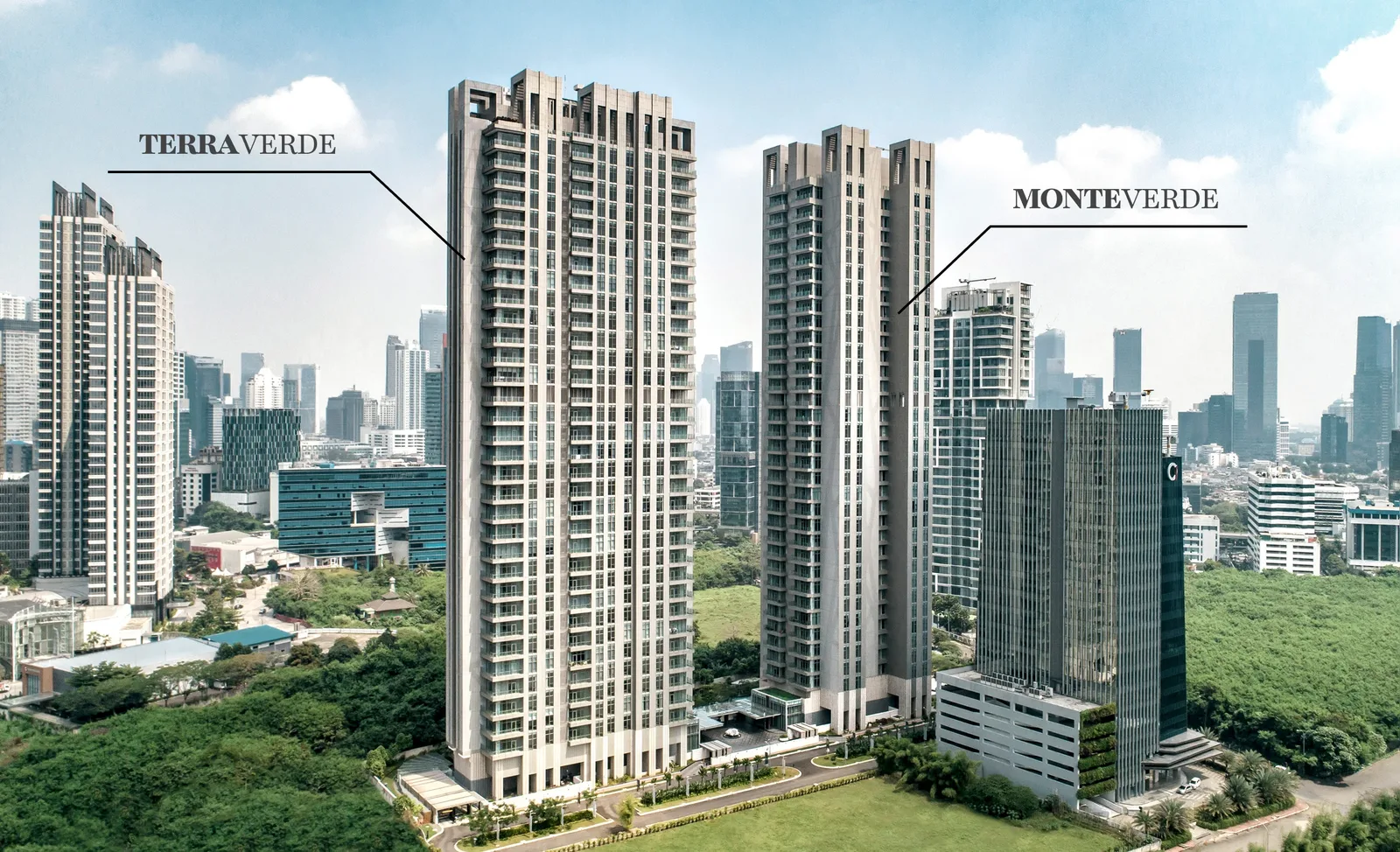
Verde Two approaches the problem from a fundamentally different direction. Instead of asking each resident to manage their own air quality with portable devices, the building treats air at the source — before it enters any individual unit.
The system is a double PM2.5 filtration design integrated into the building's mechanical ventilation infrastructure. Outside air passes through two stages of filtration before it is distributed through the building's HVAC system. By the time air reaches your apartment, the particulate load has already been reduced at a level that no single portable purifier can match, because it treats the entire air supply rather than chasing particles room by room.
This is paired with Double Low-E glass across the building's facade. Low-E (low emissivity) glass has a microscopically thin metallic coating that reflects infrared heat and ultraviolet radiation while allowing visible light to pass through. The practical effect: rooms stay cooler without heavy air conditioning load, UV damage to furniture and skin is reduced, and street noise is dampened. The glass also reduces the thermal incentive to open windows — which is how unfiltered air gets in.
These are not retrofit additions. They were designed into Verde Two from the start, which is part of why the building achieved something no other high-rise residence in Indonesia has: EDGE Zero Carbon certification from IFC, part of the World Bank Group.
EDGE (Excellence in Design for Greater Efficiencies) is a green building standard administered by IFC in collaboration with Green Building Council Indonesia. Zero Carbon is the highest certification level. To qualify, a building must first achieve EDGE Advanced status (requiring at least 40 percent on-site energy savings), then demonstrate at least 20 percent water savings and 20 percent embodied energy savings, and finally achieve annual operational carbon neutrality through on-site renewables or verified carbon offsets from Gold Standard, Verra VCS, or similar registries. The building must have operated for at least one year at 75 percent or higher occupancy before certification is granted.
Verde Two's verified numbers: 43 percent energy savings, 26 percent water savings, and 45 percent less embodied energy compared to the local baseline. The certification was formally awarded in February 2025 — the first for any high-rise residential building in Indonesia.
This matters because it is not a marketing claim. It is a third-party verification by an arm of the World Bank, based on measured operational data, not design projections.
Want to see how the air filtration system works in person? Walk through Verde Two with us.
Schedule a private viewingThe Economics of Clean Air — What It Means for Property Value
Air quality is not just a health issue — it is an economic one, both at the city level and the individual property level.
4–9% Rental Premium
Asia-Pacific green-certified residentialGreen-certified apartments across Asia-Pacific markets command 4 to 9 percent higher rents than comparable non-certified properties, according to a 2025 WorldGBC Asia-Pacific report.9.1% Rent Premium
LEED-certified apartments globallyA Georgetown University study found that LEED-certified apartments achieve 9.1 percent higher rent over market average, while even non-certified green buildings see a 4.7 percent premium.65.4% Occupancy
Jakarta condo five-year high (Q2 2025)Jakarta's condo market hit a five-year high occupancy of 65.4 percent in Q2 2025 (Cushman & Wakefield), signalling recovery and growing demand for quality residential stock.Up to 25% Utility Savings
Zero-carbon building residentsWRI estimates that residents of zero-carbon buildings save up to 25 percent on utilities through efficient systems, better insulation, and reduced cooling loads.For buyers and investors, the calculus is straightforward. A building with IFC-verified green credentials and measurably cleaner indoor air is not just more pleasant to live in — it commands higher rents, attracts quality tenants faster, and holds value better in a market where air quality awareness is growing every year. For a side-by-side comparison of certified and uncertified buildings, see our luxury apartment buyer's checklist.
For renters, especially expatriates and corporate relocations, a certified building simplifies the conversation with HR departments and relocation agencies. EDGE Zero Carbon from IFC is a credential they recognise. It makes the case for a higher housing allowance defensible.
Frequently Asked Questions About Jakarta Air Quality
More guides
Ready to breathe cleaner air at home?
Tell us what you need: a viewing, rental enquiry, or purchase consultation. We reply fast on WhatsApp. Viewings are booked at least 1 day ahead (H-1).
Chat with us on WhatsApp